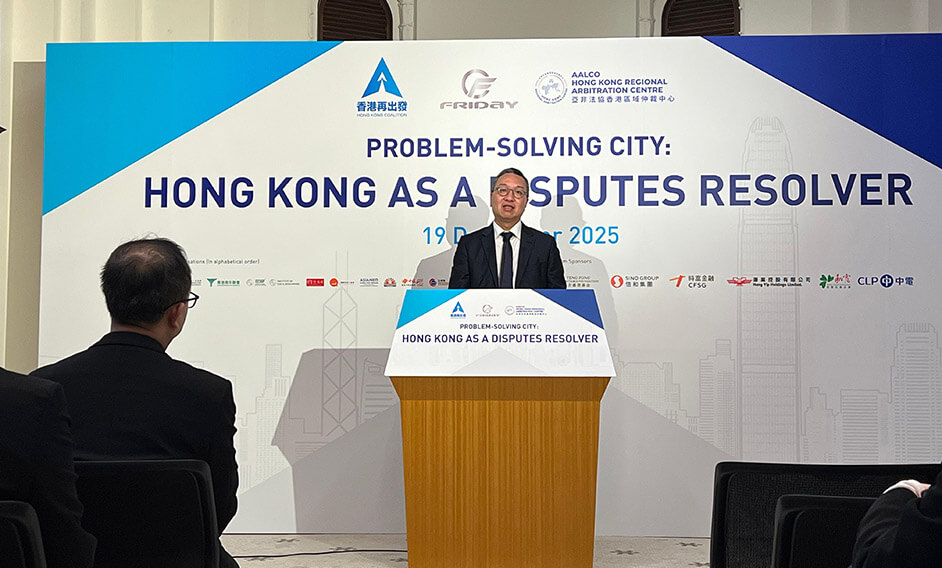
Following is the keynote speech by the Secretary for Justice, Mr Paul Lam, SC, at the 5th International Forum on "Problem-Solving City: Hong Kong as a Disputes Resolver" today (December 19):
Ms Maria Tam (Deputy Secretary-General of the Hong Kong Coalition), Professor Herman Hu (Chairman of Friday Culture Limited), Mr Nick Chan (Director of the AALCO Hong Kong Regional Arbitration Centre), distinguished guests, ladies and gentlemen,
A very good afternoon. I am very grateful to have the opportunity to speak at the 5th International Forum, co-organised by Friday Culture Limited, the Hong Kong Coalition and the AALCO Hong Kong Regional Arbitration Centre. I would like to begin by expressing my appreciation to the organisers for their ongoing efforts in hosting this event.
This year's theme, "Problem-Solving City: Hong Kong as a Disputes Resolver, Transnational Connector and Cultural Bridge", aptly captures one of Hong Kong's unique roles and is especially relevant at a time of global uncertainty. As economies and communities around the world navigate post-pandemic recovery, rapid digitalisation, and shifting geopolitical landscapes, the ability to connect, mediate, and build trust across boundaries is essential.
Hong Kong has long been recognised as a premier global hub for dispute resolution, supported by a robust legal framework, world-class institutions and professional talent, as well as an independent and efficient judiciary. The establishment of the International Organization for Mediation (IOMed) Headquarters in Hong Kong further reinforces Hong Kong's status as a centre for peaceful dispute resolution. As the world's first intergovernmental legal institution dedicated to resolving international disputes through mediation, the IOMed provides an additional avenue for handling disputes between states, between a state and foreign nationals, as well as international commercial disputes.
On the other hand, Hong Kong continues to serve as a transnational connector and cultural bridge, linking East and West through its strategic location, multilingual environment, and active participation in initiatives such as the Belt and Road Initiative. This blend of Chinese heritage and international vision enables the city to act as a gateway connecting the Chinese Mainland with the world, fostering mutual understanding and forging enduring partnerships with the global community.
Today's programme, with its two engaging panels: "Mediating Disputes in Sports" and "Setting and Harmonising Standards for Web 3.0", offers a timely opportunity for thoughtful exchange. Please allow me to offer a few very brief observations ahead of the discussions by the panellists.
Mediating disputes in sports
With the hosting of competition events during the 15th National Games and the opening of the Kai Tak Sports Park, Hong Kong's sports sector is experiencing continuous development. As the industry grows, so does the need for effective dispute resolution services tailored to address sports-related issues, from commercial and contractual disputes to competition and governance issues.
A dedicated and streamlined mechanism for resolving sports-related disputes is pivotal to advancing Hong Kong's sports development. Delays in resolution can derail a sportsman's career or disrupt the operation of a sports organisation. A reliable and effective dispute resolution framework will not only safeguard the interests of the sportsmen and sports bodies but also increase confidence, stability and professionalism across the sector. As an international legal and dispute resolution services centre, Hong Kong is well positioned to become a trusted hub for sports dispute resolution.
Globally, the sports dispute resolution landscape has made considerable progress. The Court of Arbitration for Sport (CAS) headquartered in Switzerland, with its global network of arbitrators and mediators, provides structured mechanisms for adjudicating sports disputes efficiently and transparently. On the Chinese Mainland, the establishment of the China Commission of Arbitration for Sport (CCAS) under the revised Sports Law represents another significant step, laying the foundation for a comprehensive sports dispute resolution system in our country. These experiences offer valuable reference points for Hong Kong.
During my duty visit to Europe earlier this year, I had the opportunity to visit the office of the French National and Olympic Sports Committee (CNOSF) and meet with representatives from the Chamber of Arbitration for Sport and the Conference of Conciliators of the CNOSF. These exchanges offered valuable insights into the committee's services in sports arbitration and conciliation and highlighted the importance of nurturing a collaborative culture, in which dialogue and mutual understanding form the foundation of effective sports dispute resolution. This experience has further reinforced my belief in the importance of fostering a similar culture of structured and proactive resolution in Hong Kong.
The Hong Kong Government has indeed been proactive in developing a dedicated sports dispute resolution system. The Department of Justice (DoJ) worked closely with the sports and legal communities to establish the Pilot Scheme on Sports Dispute Resolution, which was a key policy initiative under the Chief Executive's 2024 Policy Address. I am glad that the Pilot Scheme was formally launched about a week ago on December 11. The Pilot Scheme incorporates a "mediation first, arbitration next" process, thus reinforcing the efficacy of mediation for resolving sports disputes. We are confident that mediation is particularly fitting given its speed and cost efficiency, its capacity to preserve relationships, as well as its potential to deliver creative and practical solutions.
In fact, we consider that the said initiative goes beyond a policy measure - fundamentally speaking, it is about culture building. To work towards this direction, the DoJ has long been committed to promoting the wider use of mediation in Hong Kong and deepening the mediation culture, and we see significant value in extending this to the sports sector. Please rest assured that we will continue to engage in dialogue and collaboration with partners across sectors to raise awareness and nurture talent in sports dispute resolution through educational programmes and promotional events, with the goal of cultivating a healthy and sustainable sports ecosystem grounded in knowledge, professionalism and trust.
Today's panel on "Mediating Disputes in Sports" brings together sports industry leaders, elite athletes and legal experts to share perspectives on the growing importance of mediation in sports. Their insights will shed light on how a robust, fair and efficient dispute resolution system can benefit our sporting community, thereby paving the way for Hong Kong to become a trusted hub for sports dispute resolution.
Setting and harmonising standards for Web 3.0
The second panel discussion is about setting and harmonising standards for Web 3.0. Web 3.0 represents the latest generation of the Internet, characterised by decentralisation, blockchain technology and user sovereignty. With Web 3.0, users have greater control over their data and transactions, fostering trust and transparency through cryptographic mechanisms. Coupled with the development of artificial intelligence, Web 3.0 has opened up new applications and opportunities to various sectors, including the legal and dispute resolution industry.
Web 3.0 technologies enhance enforceability and transparency in contractual obligations and create further synergy when integrated with AI. Take smart contracts as an example. Smart contracts are digital agreements stored on a blockchain, and they execute automatically. They often incorporate key contractual clauses such as dispute resolution and governing law clauses. AI smart contracts can even analyse data, adapt to different contexts and improve accuracy in future decision-making when executing the contracts. Electronic evidence is another good example. Electronic evidence can be verified using blockchain timestamping. AI can supplement it by accurately identifying, extracting and analysing digital evidence, hence ensuring the integrity and admissibility of electronic evidence. It is therefore essential for legal professionals to understand the implications and embrace these technologies to enhance efficiency in their practice.
The Government has been proactive in supporting the development of Web 3.0 in Hong Kong. In 2022, the Policy Statement on Development of Virtual Assets in Hong Kong was issued by the Financial Services and the Treasury Bureau to set out the policy stance and approach towards developing a vibrant sector and ecosystem for virtual assets in Hong Kong. Version 2.0 of the Statement was then released in June this year. The Task Force on Promoting Web3 Development, chaired by the Financial Secretary, was also established in 2023 to provide the Government with recommendations on the sustainable and responsible development of Web 3.0. With all the efforts made as aforementioned, the Stablecoins Ordinance (Cap. 656) came into effect on August 1, 2025, with a view to facilitating the sustainable development of the stablecoin and digital asset ecosystem in Hong Kong by introducing a licensing regime for fiat-referenced stablecoin issuers.
The DoJ has also actively promoted the use of Web 3.0 technologies in the legal and dispute resolution industry. With our support, eBRAM International Online Dispute Resolution Centre (eBRAM) was established to provide online dispute resolution (ODR) services. Since May 2022, eBRAM has developed a series of ODR platforms, including the Asia-Pacific Economic Cooperation (APEC) ODR Platform, an online arbitration platform, an online mediation platform, and the Deal-Making Portal, so as to facilitate business transactions and access to justice. In particular, eBRAM's Deal-Making Portal provides a set of comprehensive tools for cross-border dispute resolution and deal-making using Web 3.0 technologies such as smart contracts.
Earlier this year, we also set up the Consultation Group on LawTech Development, which will be responsible for giving advices on the formulation of policies and measures regarding lawtech. With the support of the Consultation Group, we have organised four rounds of the LexGoTech Roundtables Series and released a report on the discussions. To further demonstrate our efforts on legal technology development, we organised the inaugural Hong Kong LawTech Fest earlier this month as part of the Hong Kong Legal Week 2025.
Apart from promoting the integration of technology and AI in the legal sector, we are taking on a pivotal role in building the broader legal regime for AI governance as mentioned in the 2025 Policy Address. We will co-ordinate an interdepartmental working group to co-ordinate the responsible bureaux to review the legislation needed to complement the wider application of AI. This initiative aims to provide a facilitative yet properly controlled legal environment for the development of AI.
Furthermore, the combination of Web 3.0 and AI offers opportunities for resolving legal disputes by enhancing efficiency and lowering costs. I am confident that the panel will share more insights on why and how the standards for Web 3.0 should be set and harmonised so as to strengthen Hong Kong's position as a global hub for legal and technological innovation.
In closing, I wish to express my heartfelt appreciation again to all organisers, speakers and participants for their dedication to advancing dialogue and innovation. The strength of Hong Kong lies not only in our institutions and infrastructure but, more importantly, also in our people - their openness, professionalism and shared belief in the value of co-operation. Together, we will continue to build a city that connects cultures, bridges differences and contributes meaningfully to the global peace and development.
May I wish you all a very constructive forum this afternoon.
Ends/Friday, December 19, 2025