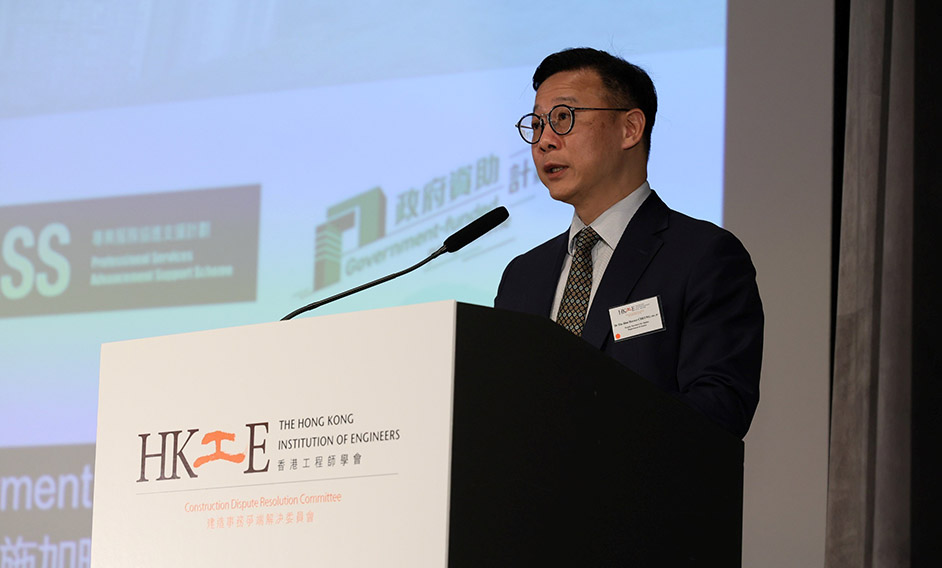
Following are the opening remarks by the Deputy Secretary for Justice, Dr Cheung Kwok-kwan, at the conference organised by the Construction Dispute Resolution Committee (CDRC) of the Hong Kong Institution of Engineers (HKIE) today (May 28):
President Chow (President of the HKIE, Ms Alice Chow), Chairman Chan (Chairman of the CDRC of the HKIE, Mr Ben Chan), distinguished guests, ladies and gentlemen,
Good morning. It is my great pleasure to join you all at today's conference.
The Department of Justice has been a staunch advocate for the amicable resolution of disputes. Over the years, we have introduced several important pieces of legislation – the Arbitration Ordinance, which provides a clear and accessible arbitration framework based on the internationally accepted UNCITRAL Model Law; the Mediation Ordinance, which promotes the adoption of mediation and safeguards the confidentiality of mediation communications; the Apology Ordinance, which encourages the making of apologies to help prevent the escalation of disputes.
At a practical level, government contracts now include a clause requiring parties to use mediation to resolve disputes before resorting to arbitration or litigation. We have also been promoting the use of alternative dispute resolution across different sectors of the community. For example, we launched a pilot scheme in 2025 to equip property managers with the necessary skills to de-escalate community disputes. In late 2025, we launched another pilot scheme to help resolve sports disputes through mediation and arbitration. Since this Pilot Scheme on Sports Dispute Resolution commenced acceptance of case application earlier this year, it has already generated one successful case in a matter of just a few months.
All these efforts over the years have earned Hong Kong the reputation of being an international dispute resolution services centre. Such reputation is well recognised around the globe. Hong Kong was ranked second globally as the most preferred seat of arbitration according to the 2025 International Arbitration Survey conducted by the Queen Mary University of London. Further, the establishment of the headquarters of the International Organization for Mediation in Hong Kong last year also manifests the importance of Hong Kong's role as a leading international dispute resolution hub.
Today's conference focuses on the implementation of the Construction Industry Security of Payment Ordinance, which came into full force last year. This new piece of legislation is indeed a welcome addition to the Government's efforts in promoting a culture of amicable dispute resolution in Hong Kong. The enactment of the Ordinance also represents an important step towards tackling a long-standing problem in the construction industry - delayed payment. It seeks to help ensure that conscientious contractors, subcontractors, and suppliers are paid on time and to prevent them from bearing undue financial risks - a situation that can lead to serious problems and disputes.
At the heart of the Ordinance are three key ideas.
First, it improves contractual payment terms by prohibiting unfair practices such as "pay when paid" clauses. It also imposes time limits for payment responses and actual payment after a payment claim is made.
Second, the Ordinance introduces an adjudication mechanism. The claiming party has the right to initiate adjudication proceedings, and the appointed adjudicator has to make a determination within the specified period. This provides a swift and practical avenue for resolving payment disputes.
Third, the Ordinance grants the unpaid party a right to suspend or reduce the rate of work or supply if payment is not made as required.
Over time, the Ordinance will foster a healthier industry ecosystem by strengthening payment security, thereby reducing the risk premiums that are often built into project costs because of payment uncertainty.
With this new statutory framework of adjudication in place, the key question is how it should be put into good use for the benefits of the industry. I would therefore like to extend my sincere thanks to the Hong Kong Institution of Engineers' Construction Dispute Resolution Committee for organising this timely conference. The conference brings together industry leaders and experts to share their crucial insights into the application of adjudication in dispute settlement. Your contributions will be crucial in fostering Hong Kong's position as a premier dispute resolution centre and a preferred place of doing business in the world.
I wish today's event every success and fruitful discussions for everyone.
Thank you.