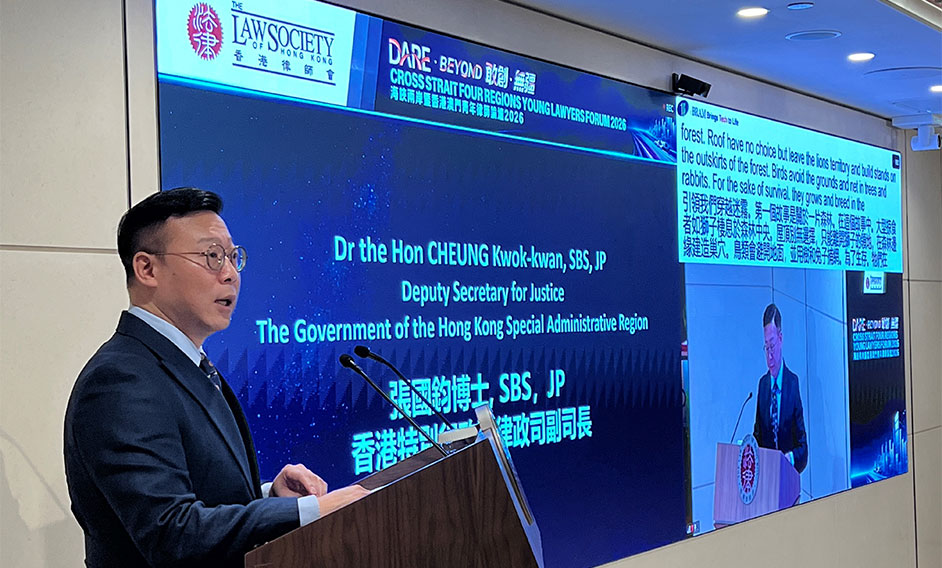
Following are the closing remarks by the Deputy Secretary for Justice, Dr Cheung Kwok-kwan, at the Cross Strait Four Regions Young Lawyers Forum 2026 today (October 17):
President Roden Tong (President of the Law Society of Hong Kong), Professor Teresa Cheng (Secretary-General of the International Organization for Mediation, Professor Teresa Cheng), Vice President Wang (Vice President of the All China Lawyers Association, Mr Wang Qingyou), President Vong (President of the Macau Lawyers Association, Mr Vong Hin Fai), Mr Hsieh (Former Chairman of the Kaohsiung Bar Association, Mr David Hsieh), distinguished guests, ladies and gentlemen,
It is my pleasure to join you all today at the Cross Strait Four Regions Young Lawyers Forum 2026. Nowadays, legal profession is entering a period of profound transformation, standing at a unique historical juncture where technological boundaries are being constantly redefined, the rule-based international order is being challenged and economic realities are being shifted. Whether you like it or not, the changing landscape is reshaping the world that we serve, and urging a response from the legal profession.
In response to this changing landscape, it requires much more than technical changes in our legal practice. What we need is a holistic and broader approach which allows us to find out the role that lawyers play in contemporary world. In this connection, I would like to share with you stories that may guide us through the mist.
The first story is about a forest. In this story, large predators such as lions occupy the central part of the forest; wolves have no choice but leave the lion's territory and build dens on the outskirts of the forest; birds avoid the ground and nest in trees; and rabbits, for the sake of survival, dig burrows and breed in the grasslands outside the forest.
This ecosystem makes sense. Small animals cannot compete with strong predators, so they can only avoid the strong in terms of time, space, food, and other aspects, and seek a place that is more suitable for survival.
In another story—California gold rush. Gold was found and the first batch of pioneers went to California to pan for gold and became rich, and their success attracted more people to California to seek gold. Suppose you were a young man at that time: would you join the gold rush? If you did not go, you would miss an opportunity to get rich. If you did go, not everyone who panned for gold would become rich. As more and more people joined the gold rush, the chance of striking it rich through gold panning became smaller and smaller, to the point that it was even worse than taking an ordinary job back home.
Thinking out of the box — perhaps you should go! But not to pan for gold. Rather, to sell jeans there. The gold miners might not make money, but they needed durable trousers for tough mining work. So, selling jeans could make you rich. This is exactly the founding story of the jeans brand Levi's.
Xiaomi Technology is a good example for our reference. At first, Xiaomi was just an ordinary company that made mobile phones, with high cost-effectiveness. But in the face of strong rivals such as Huawei, Lenovo, and even Apple and Samsung, relying solely on a mobile phone price war would not be sustainable. So how could Xiaomi break through?
Xiaomi's founder Lei Jun came up with an inspiring solution: to break out of the dead end of the mobile phone price war and build a Xiaomi ecosystem chain. The so-called Xiaomi ecosystem chain refers to small home appliance products, such as televisions, robot vacuum cleaners, air purifiers, water filters, rice cookers, cameras, routers, and various other smart home appliances.
Why should a mobile phone company produce various smart home appliances? Xiaomi thought from a completely new ecological perspective: a mobile phone can connect with all smart home appliances to build a smart home ecosystem, and the mobile phone serves as the hub of this ecosystem. In other words, the mobile phone is no longer just a mobile phone; it is the gateway to the entire smart home world.
For other mobile phone manufacturers, a phone is just a phone, and they rely on selling phones to make a profit; but Xiaomi's phone is an ecosystem gateway, with many other sources of profit.
Let us now return to our real legal services market. When we face strong competitors, or when the market is already nearing saturation, can we refer to the forest story and explore opportunities in the Greater Bay Area, and even more strategically in the less competitive prefecture-level cities within the Greater Bay Area?
When we find that our business has no competitive edge over the peers or is merely engaged in cutthroat competition, can we refer to the gold rush story and Xiaomi's success story, and actively explore new practice areas such as artificial intelligence, innovative technology, virtual assets, and even space law?
Ladies and gentlemen, the theme of today's forum is "Dare • Beyond". I will therefore leave it to be discussed and decided by your good self as to what we dare to do and what aspects we are prepared to go beyond. Thank you.
Ends/Saturday, October 17, 2026